



In Kaskas’s new office on Merimiehenkatu, many pieces of furniture have been part of Kaskas, or its founders’ lives, for a long time. The red sofa comes from the childhood home of founder Maria Ruuska. The other founder, Liisa Mayow, slept on it as a teenager during sleepovers. Now the sofa has been reupholstered and carries on its life at the office.
Liisa’s brother Feodor Mayow built two of the office tables as his graduation project in Kaskas’s early days, and they were already in use in the agency’s previous offices. The large table in the meeting room, meanwhile, was a second-hand find sourced specifically for the new space. Getting it through the door eventually took a team of piano movers.
When we started looking for a designer for the new office, Joanna Laajisto was an obvious choice. Over the past two years she has reoriented her practice around designing within planetary boundaries, which in practice means pushing circular thinking into the design process as far as it will go.
Start with what’s already there
For Laajisto, the design of Kaskas’s office began with the single most important principle of the circular economy: keep what you have. The new space had been chosen so that no major structural work was needed.
That is a significant change from how she used to work.
“Earlier in my career I was used to starting more or less from a blank slate. First you strip the space, then you build something in it that’s perfect for that particular client. You pick materials from the library, and the only limit is your imagination. This time we started by looking at the space as it was. How do we make this as good as it can be with the fewest possible changes?”
Working that way means spending more time in the space itself doing measuring, looking and thinking. At Kaskas, Laajisto also went carefully through all the furniture from the old office.
Old things gather value
Things gather stories as they’re used, and Laajisto believes that over time the value of those stories can outweigh visuals polished to the last detail.
The same goes for any material that has already been produced. Laajisto says she worries in particular about the consumption of natural resources.
“There is already so much material in the world. We should be finding value in that and using it again. Things aren’t disposable. And this doesn’t just apply to marble or solid timber, it applies to every material.”
Laajisto thinks that things are worth keeping for as long as they’re useful. Being bored of something, or seeing a trendier version on social media, shouldn’t be reason enough to throw something out.
Aesthetics have to change too
The circular economy inevitably changes how spaces look. Recycled materials don’t always match perfectly, surfaces made from offcuts can be uneven, and there’s rarely a good reason to replace an existing pipe or cable run purely for appearance’s sake. Laajisto describes herself as having been a meticulous, controlling designer. She has had to learn to look at spaces more forgivingly.
“I’ve had to let go of perfectionism. I also think aesthetics can carry a little less weight than they used to. What matters more is that this is a space with value to it, that its values are right, that it’s been done in a good way. That feels better, somehow, than having everything brand new and gleaming.”
Beauty isn’t a fixed standard, either because every era finds different things beautiful. If we want materials to circulate better than they do now, Laajisto argues, our sense of aesthetics has to become more flexible too.
What matters more to her is how a space feels rather than how it looks. A space can be a wonderful place to be even if it doesn’t produce the perfect Instagram shot.
“We’re not building stage sets.”
Unlearning the chase for the new
Laajisto talks about the “dopamine chase” behind buying new things. Interior design, she says, has started to resemble the trend cycles of fashion and cosmetics, even though we’re talking about far bigger purchases meant to last far longer.
“We all need to unlearn that, because these are such big purchases. You can’t fall in love with a new interiors trend every year.”
Changing consumer habits alone won’t be enough though. Choosing second-hand needs to get easier than it is now. At the moment, furniture and materials are tracked down on online marketplaces, at auctions and wherever else they turn up. Laajisto calls this circular economy hustling. She would like to see more high-quality circular operators in the market, and clear procurement channels for businesses, so that buying old could be as straightforward as buying new. Tax policy, she adds, could also be used to make the circular economy easier.
For Laajisto, none of this has meant compromising on creativity. Quite the opposite.
“The space wouldn’t have been any better with new furniture.”
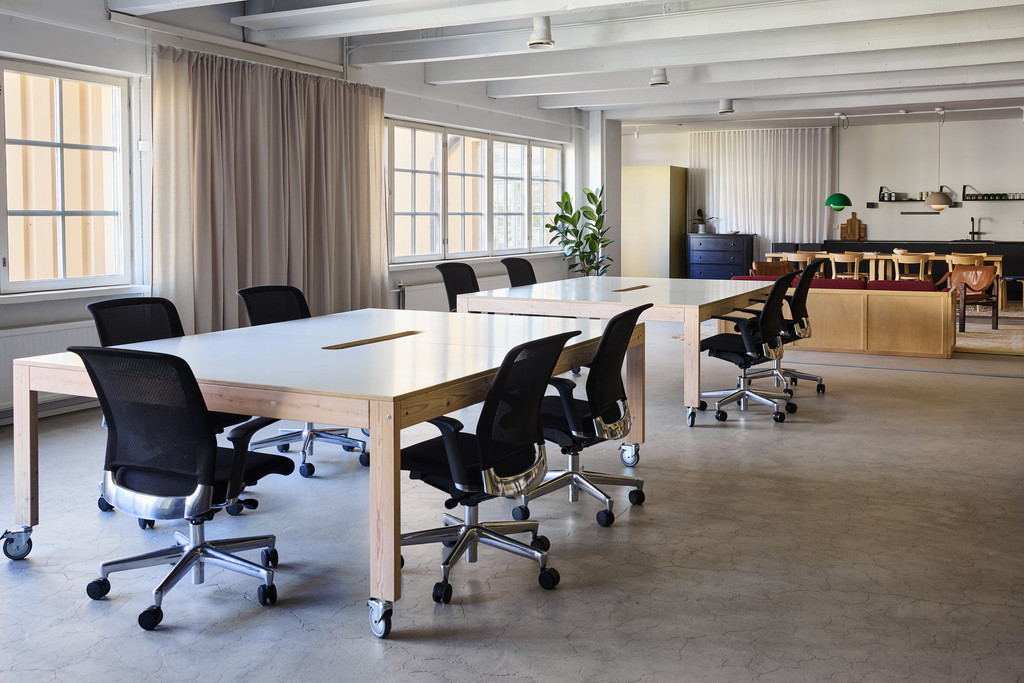
Photos by Mikko Ryhänen